
Local Claims Response: Louisiana Short Term Rental Insurance
If you rent your property on Airbnb, Vrbo, or through direct bookings, you need short term rental insurance or a written home-sharing endorsement from your insurer, not just a standard homeowners policy. The moment you accept your first guest for pay, you’re running a business, and most homeowners and landlord policies were never written to cover that. Notify your insurer today, document your bookings, and confirm your local licensing minimums before your next reservation lands.
TL;DR:
- Most hosts need a dedicated short-term rental policy or endorsement, as homeowners policies exclude the frequent guest turnover and liability exposures.
- Proper coverage protects property, contents, liability up to at least one million dollars, and loss of rental income, which platform protections do not cover.
- Costs for a dedicated policy generally range from $2,000 to $3,000 annually, with higher premiums for amenities, location risks, and increased liability limits.
- Local licensing often requires minimum liability coverage of $500,000 to $1 million, making it essential to verify and meet these standards before listing.
- Choosing an insurer with clear coverage scope, adequate liability limits, and responsive, local support reduces claim disputes and financial risks.
Table of Contents
- What Is Short Term Rental Insurance and Why Does It Differ From Homeowners Coverage?
- What Does a Short-Term Rental Policy Typically Cover?
- How Much Does Short-Term Rental Insurance Cost and What Drives the Price?
- How Do You Get Properly Insured for a Short-Term Rental?
- When Might a Homeowners or Landlord Policy Still Work?
- How Do Pools, Hot Tubs, and Events Change Your Coverage Needs?
- What Licensing and Insurance Minimums Should You Check Locally?
- How Do You Choose the Right Short-Term Rental Insurance Provider?
- Why Local, Experienced Agency Support Changes Claim Outcomes
- Why Protection Beats the Cheapest Premium Every Time
- How The Root Agency Helps Hosts Close Coverage Gaps
- Sources
- FAQ
What Is Short Term Rental Insurance and Why Does It Differ From Homeowners Coverage?
Short-term rental insurance covers a property rented out frequently, often for stretches as short as a night or a weekend, to paying guests you don’t know personally. That frequent turnover is what makes it commercial activity in the eyes of nearly every insurer, and commercial activity is exactly what a standard homeowners policy is built to exclude.
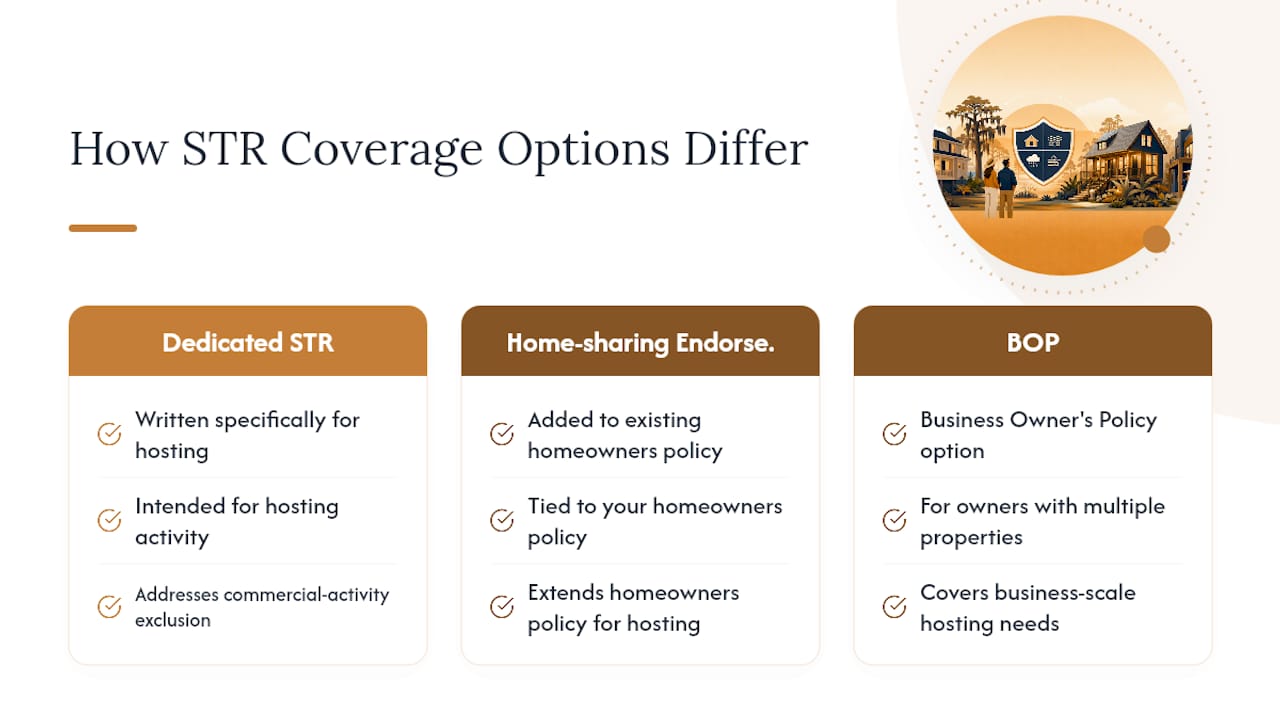
You’ll typically encounter three ways to get covered: a dedicated short-term rental policy written specifically for hosting, a home-sharing endorsement added to an existing homeowners policy, or a Business Owner’s Policy (BOP) for owners running multiple properties or treating hosting as a full business. Each fills a different gap.
The Insurance Information Institute warns that failing to secure the right commercial coverage can lead to denied claims or outright policy cancellation. That’s not a technicality. It’s the difference between a burst pipe getting fixed and a burst pipe costing you the whole property. Allstate’s own guidance confirms homeowners policies have real limits here and points hosts toward specific endorsements rather than assuming coverage carries over automatically.
What Does a Short-Term Rental Policy Typically Cover?
A properly built short-term rental policy protects four distinct areas, and hosts who only skim the declarations page tend to discover the gaps at the worst possible time.
- Property and building coverage pays for structural damage from fire, wind, and other covered perils, essentially the same protection a homeowners policy offers, but written for a property with paying guests cycling through.
- Contents coverage protects furniture, appliances, and décor, and it usually distinguishes between normal wear and guest-caused damage, which matters when a security deposit doesn’t cover a broken sectional.
- Liability coverage protects you if a guest gets hurt on your property. A $1 million per-occurrence limit has become the common baseline among hosts who take this seriously, not because it’s excessive, but because a single slip-and-fall lawsuit can exceed that number fast.
- Loss of rental income (business interruption) reimburses you when the property can’t be rented after a covered loss, like fire or storm damage forcing weeks of cancellations.
Here’s what most hosts don’t realize: neither Airbnb’s AirCover nor Vrbo’s host protections replace any of this. Industry guidance is direct about AirCover functioning as a limited reimbursement program with real exclusions, and lost rental income sits outside its scope entirely. If your listing goes dark for six weeks after a kitchen fire, the platform isn’t the one making you whole. Your policy is.
Per-stay damage protection plans, the kind you might buy through a booking platform, work differently. They resolve small, frequent losses like a stained rug or a broken lamp quickly and without touching your premium, but they were never designed for a burst water heater or a total loss. Think of them as a deductible-free layer for nuisance claims, sitting on top of real insurance, not instead of it.
How Much Does Short-Term Rental Insurance Cost and What Drives the Price?
A dedicated policy for a single property typically runs $2,000 to $3,000 per year, with loss-of-income add-ons costing another $100 to $400 annually. Those numbers vary more than most hosts expect, and the variation almost always traces back to a handful of factors.
What drives your premium up or down:
- Location and its exposure to hurricanes, flooding, or crime (a coastal Louisiana property carries very different risk than an inland one)
- Occupancy rate, since more nights booked means more exposure to claims
- Property value and replacement cost
- Amenities like pools, hot tubs, or fire pits that raise liability exposure
- Claims history, both yours and the property’s
The trade-off worth understanding: pushing your liability limit from $500,000 to $1 million, or adding meaningful loss-of-income coverage, usually costs a modest increase in premium relative to what it protects. Skipping that increase to save a few hundred dollars a year is the kind of decision that looks fine right up until a guest files a lawsuit or a hurricane shuts your property down for two months.
You can manage cost without gutting coverage. Bundling your short-term rental policy with other lines, insuring multiple properties under one policy, and making safety upgrades like updated wiring or monitored security systems all tend to soften the number on your renewal. Hosts who implement clear screening protocols and house rules also report meaningfully fewer damage incidents, which shows up in your claims history and, eventually, your premium.
How Do You Get Properly Insured for a Short-Term Rental?
Getting this right isn’t complicated, but skipping a step is exactly how hosts end up with a denied claim after the damage is already done.
- Document your rental activity across every channel. List which platforms you use, Airbnb, Vrbo, direct bookings, and how many nights you typically host by exploring options like Smoky Mountain Cabin Rentals. Insurers price risk based on actual usage, not guesses.
- Notify your insurer or agent early. Ask directly whether a home-sharing endorsement fits your situation or whether you need a dedicated short-term rental policy. Don’t wait for a renewal notice to bring this up.
- Verify your liability limits and loss-of-income language. Read the vacancy and occupancy clauses carefully. Some policies quietly reduce coverage if the property sits empty beyond a certain number of days.
- Use per-stay damage protection for the small stuff, but never treat it as a substitute for your annual policy. It handles the stained couch, not the flooded first floor.
- Keep detailed records, guest logs, house rules, safety inspection dates, and booking confirmations across every channel.
That last step matters more than most hosts assume. Adjusters rely heavily on booking records and guest communications to allocate loss and confirm which reservations were affected when you file a loss-of-income claim. Without that paper trail, even a legitimate claim can drag out or get underpaid.
Pro Tip: Save a screenshot of every booking confirmation the moment a guest reserves, not after checkout. If you ever need to prove a cancellation loss, a time-stamped record beats a platform dashboard that only shows current bookings.
When Might a Homeowners or Landlord Policy Still Work?
Not every host needs a full commercial policy on day one, but the situations where a standard policy suffices are narrower than most owners assume.
- A home-sharing endorsement can work if you’re renting a room in your primary residence for limited nights per year and remain owner-occupied most of the time.
- A landlord policy is built for long-term tenants on annual leases. It rarely accounts for the frequent turnover, guest liability exposure, or loss-of-income needs of true short-term hosting, and coverage gaps show up fast if you’re actually running an Airbnb-style operation.
- Common exclusions to watch for: business activity exclusions, “vacant beyond X days” clauses, and outright bans on paying, non-family occupants. Running short-term rentals without disclosing it to your insurer can void coverage entirely, even for claims that have nothing to do with a guest.
If your hosting volume grows past a few nights a year, it’s worth comparing your existing homeowners policy against a proper landlord or commercial option rather than assuming the endorsement still fits.
How Do Pools, Hot Tubs, and Events Change Your Coverage Needs?
A pool or hot tub doesn’t just add a nice photo to your listing. It multiplies your liability exposure, and insurers know it.
- Pools and hot tubs are among the top drivers of increased premiums and stricter conditions. Expect insurers to require fencing, posted depth and safety signage, and rescue equipment on-site before they’ll extend full liability coverage.
- Liquor liability and event coverage come into play if your listing hosts weddings, parties, or gatherings where alcohol is served. Standard STR policies often exclude this entirely, meaning you need a separate rider if your property markets itself as an event space.
- Higher limits and umbrella coverage get requested by insurers once amenities stack up. A property with a pool, a hot tub, and event hosting all at once is a different risk profile than a quiet two-bedroom cottage, and your policy needs to reflect that.
Pro Tip: If your listing photos show the pool front and center, expect your insurer to ask about it directly. Answering honestly and installing the required safety measures upfront is far cheaper than a claim denial after an incident.
An umbrella policy is often the most efficient way to layer extra liability protection on top of your existing limits, especially once amenities push your exposure higher than a standard policy comfortably covers.
What Licensing and Insurance Minimums Should You Check Locally?
Cities across the country have been tightening short-term rental rules, and insurance minimums are usually part of that shift. Many municipalities now require $500,000 to $1 million in liability coverage as a condition of licensing, and that trend is only spreading.
Proof of insurance increasingly ties directly into permitting. Some cities require you to submit a certificate of insurance before they’ll issue or renew your short-term rental license, and some booking platforms now ask hosts to confirm coverage as part of their compliance checks. Showing up without it can mean losing your permit, not just facing a claim gap.
Before you list another night, check your city and parish requirements directly. Louisiana municipalities vary in how they regulate short-term rentals, and a liability minimum that satisfied your permit two years ago may no longer meet current rules. Build that number into your coverage decision rather than treating it as a formality to handle later.
How Do You Choose the Right Short-Term Rental Insurance Provider?
Comparing policies on premium alone is how hosts end up underinsured. Evaluate on substance instead.
- Scope of coverage. Does the policy cover property, contents, liability, and loss of rental income, or does it quietly skip one?
- Liability limits. Does the base policy meet your city’s minimum, and does it leave room to grow if you add amenities later?
- Loss-of-income language. How many days of vacancy trigger a reduction in coverage, and does the policy cover cancellations across every platform you use?
- Exclusions. Read what’s carved out, especially around water damage, mold, and high-occupancy events.
- Claims handling timeframe. Ask directly how fast the insurer typically resolves a claim, and whether that’s handled locally or through a call center.
Questions worth asking any agent before you sign: Does this policy require a specific home-sharing endorsement, or is it a standalone STR policy? Does coverage follow me across Airbnb, Vrbo, and direct bookings, or only one channel? Are there sublimits on pool, hot tub, or event liability? What’s the vacancy clause?
Pro Tip: If an agent can’t answer your vacancy and cross-platform questions without checking, that’s a red flag. Coverage details like this shouldn’t require a callback.
A provider who hesitates on any of these questions, or who can’t explain their claims process in plain language, is worth a second opinion before renewal.
Why Local, Experienced Agency Support Changes Claim Outcomes
Steve Root has spent more than 20 years running The Root Agency, built on a Louisiana insurance legacy that stretches back 40 years in his family. That kind of tenure means firsthand experience with the claims that actually happen here, hurricane damage, flooding, guest liability disputes, not theoretical risk on a spreadsheet.
Some agencies operate mobile catastrophe response units that deploy RVs directly to disaster zones so hosts aren’t left waiting on hold while their rental income stalls. Combined with bilingual claims support, that local presence can shorten claim resolution and help get rental income flowing again faster than a call-center model.
Why Protection Beats the Cheapest Premium Every Time
Underinsurance is the single most common, and most devastating, mistake I see hosts make. It rarely looks like a mistake in the moment. It looks like saving a few hundred dollars a year, right up until a claim gets denied or a lawsuit exceeds a liability limit that was never adjusted to match the property’s real exposure.
Local, responsive service and a catastrophe response team that shows up in person after a storm aren’t luxuries. They’re what separates a manageable setback from a financial disaster. If you haven’t reviewed your short-term rental policy with an agent in the last year, do it before your next booking, not after your next claim.
— Steve Root
How The Root Agency Helps Hosts Close Coverage Gaps
The Root Agency’s approach to short-term rental coverage starts with a straight answer: what you have now, and what you actually need. Rather than pushing the cheapest policy on the shelf, we walk through your booking volume, your amenities, and your local licensing minimums, then build coverage around your actual risk instead of a generic template.
That review can include commercial or landlord policy comparisons for owners scaling into multiple properties, flood and umbrella add-ons for properties near water or with pools, and bilingual claims support around the clock when something goes wrong. An agency with many five-star Google reviews and local recognition has built its reputation on showing up with a mobile catastrophe response unit that reaches disaster zones when hosts need it most. Explore the full range of personal and commercial coverage options, including the commercial and BOP coverage many multi-property hosts need, and call (225) 926-0160 to schedule a short-term rental coverage review with an agent who will actually pick up the phone.
Sources
- Short-Term Rentals and Homeowners Insurance
- Short-Term Rental Insurance: Why It’s Needed and Options (2026) | Hostfully
- Short-Term Rental Insurance Guide (Airbnb/VRBO) 2026 | 1-800-INSURANCE
- Does Homeowners Insurance Cover Short Term Rentals? - Allstate
This article is general information, not a substitute for advice from a qualified financial advisor. Consult a qualified financial professional about your own circumstances before acting on anything here.
FAQ
Do I Need Rental Insurance for Airbnb Hosting?
Yes. Standard homeowners insurance typically excludes commercial hosting activity, and platform protections like AirCover don’t replace a real policy. You need either a dedicated short-term rental policy or a home-sharing endorsement, plus liability coverage that meets your city’s licensing minimum.
What’s the Difference Between Homeowners and Short-Term Rental Insurance?
Homeowners insurance is written for owner-occupied residences with no paying guests. Short-term rental insurance, or a home-sharing endorsement, covers frequent guest turnover, guest liability, and lost rental income, which homeowners policies were never designed to handle.
How Much Does Short-Term Rental Insurance Cost?
A dedicated policy for one property typically runs $2,000 to $3,000 per year, with loss-of-income add-ons costing another $100 to $400 annually. Actual cost depends on location, occupancy rate, amenities, and claims history.
Does Airbnb’s AirCover Replace the Need for Insurance?
No. AirCover is a limited reimbursement program with exclusions, and it does not cover lost rental income. Hosts still need a dedicated policy or endorsement to cover catastrophic losses and business interruption.
Does The Root Agency Offer Short-Term Rental Coverage Reviews?
Yes. The Root Agency reviews existing homeowners and landlord policies for short-term rental gaps and helps hosts compare commercial, umbrella, and flood coverage options. Current pricing and policy details are available by calling (225) 926-0160 or visiting the products page.