

What Does Renters Insurance Cover in Louisiana?

Renters insurance is defined as a personal lines policy that protects tenants against financial loss from theft, fire, liability claims, and displacement costs when a covered event makes their rental uninhabitable. Most renters in Louisiana and Mississippi carry this coverage under what the industry formally calls an HO-4 policy. Your landlord’s policy covers the building. It does not cover your furniture, your laptop, or the medical bills if a guest gets hurt in your apartment. Understanding what does renters insurance cover, and where it stops, is the difference between recovering quickly after a loss and starting over from nothing. At roughly $148 per year nationally, it is one of the most affordable financial protections available to renters anywhere in the country.
What does renters insurance cover in a standard policy?
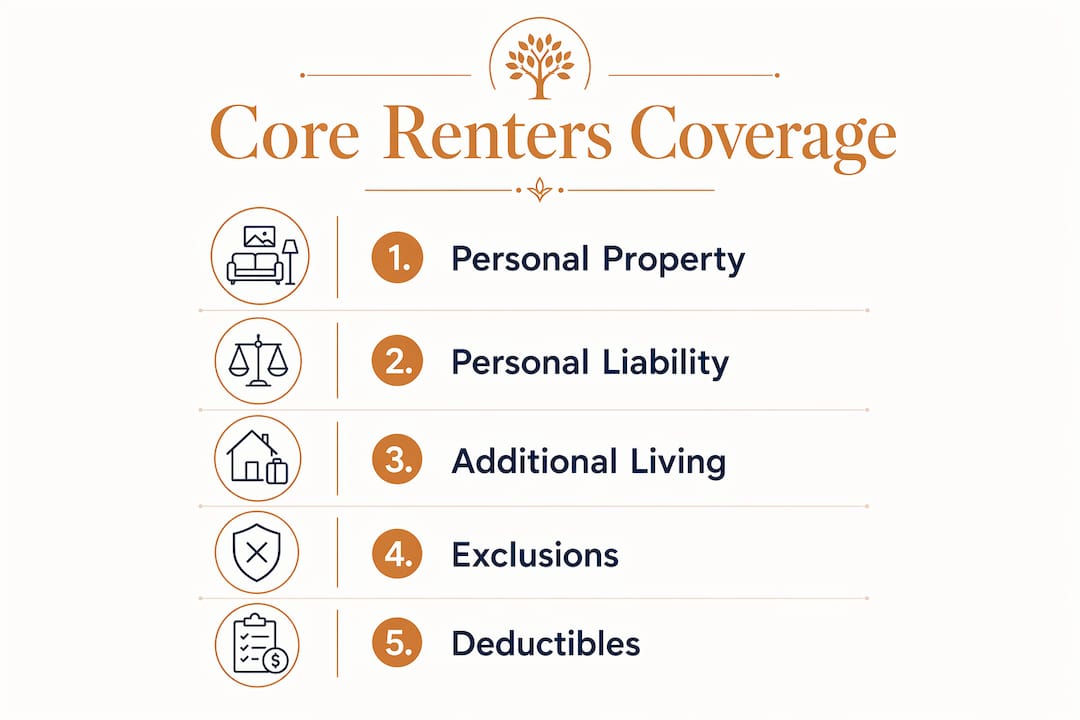
A standard HO-4 renters policy covers three core areas: personal property, personal liability, and additional living expenses. Each one addresses a different kind of financial exposure, and together they form a complete safety net for tenants.
Personal property coverage
Personal property coverage pays to repair or replace your belongings when they are damaged or destroyed by a covered peril. Covered perils typically include fire, smoke, theft, vandalism, windstorm, and certain types of water damage such as a burst pipe. They do not include flood damage, which is a critical distinction for anyone living in Louisiana or Mississippi.

The coverage applies to your belongings whether they are inside your apartment or not. If someone steals your laptop from your car or your luggage is stolen at Louis Armstrong New Orleans International Airport, your renters policy can cover that loss. That portability surprises most first-time policyholders.
Pro Tip: Take a room-by-room video inventory of your belongings and store it in cloud storage. If you ever file a claim, that footage is worth more than any receipt.
Personal liability coverage
Liability coverage protects you when you are legally responsible for injuring someone or damaging their property. This includes situations like a guest slipping on a wet floor in your apartment, your dog biting a neighbor, or accidentally leaving a candle burning that damages the unit next door. It covers legal defense costs and court judgments up to your policy limit. That protection matters more than most renters realize until they are sitting across from an attorney.
Additional living expenses
Additional living expenses (ALE) coverage pays for hotel stays, restaurant meals, and other costs above your normal living expenses when a covered event forces you out of your rental. If a kitchen fire makes your apartment uninhabitable for three weeks, ALE keeps you housed and fed while repairs happen. For renters in storm-prone areas like Baton Rouge or Biloxi, this coverage can be the difference between a manageable disruption and a financial crisis.
What renters insurance does not cover
Standard renters insurance excludes several categories of loss that are especially relevant to Louisiana and Mississippi tenants. Knowing these gaps before a storm hits is what separates prepared renters from those who discover the truth at the worst possible moment.
The most significant exclusion is flood damage. Flood and earthquake damage are not covered by any standard renters policy. For renters in New Orleans, Baton Rouge, Jackson, or anywhere along the Gulf Coast, that exclusion carries real weight. A separate flood insurance policy through the National Flood Insurance Program (NFIP) or a private carrier is the only way to cover belongings lost in a flood event. You can learn more about why this matters locally in our guide on flood insurance in Louisiana.
Other common exclusions include:
- Pest damage: Termites, rodents, and bed bugs are not covered. Pest control and resulting repairs are the tenant’s responsibility.
- Landlord’s property: Your policy covers your belongings, not the building, appliances owned by the landlord, or structural damage. Landlord policies cover the building, not tenant belongings or liability.
- High-value items above per-item limits: Standard policies cap payouts on jewelry, art, firearms, and electronics at relatively low per-item limits. A $5,000 engagement ring may only receive $1,500 under a base policy.
- Business equipment used for work: If you run a business from your apartment, commercial-grade equipment may not be covered under a personal renters policy.
Pro Tip: If you own jewelry, collectibles, or specialized equipment worth more than a few hundred dollars per item, ask about a scheduled personal property endorsement. It removes the per-item cap and covers the full appraised value without a complicated claims evaluation.
How much renters insurance do you actually need?
Choosing the right coverage amount is where most renters make their biggest mistake. They pick a number that feels reasonable without ever adding up what they actually own.
Start with a thorough home inventory. Walk through every room and list your belongings with approximate values. High-value items like e-bikes can cost $2,000–$5,000 each, and professional work gear or hobby equipment adds up fast. Most renters who do this exercise for the first time discover they own $30,000 to $50,000 in personal property. That number should anchor your coverage limit, not a guess.
Replacement cost vs. actual cash value
This distinction directly affects how much you receive after a claim. Replacement Cost policies pay what it costs to buy a comparable item new today. Actual Cash Value (ACV) policies pay the depreciated value of what you lost. A three-year-old television that cost $800 might pay out $200 under ACV. Replacement Cost coverage costs slightly more in premiums, but it is the only version that actually makes you whole after a loss.
Liability limits and landlord requirements
Landlords in Louisiana and Mississippi typically require liability coverage between $100,000 and $300,000 and personal property limits between $20,000 and $50,000. Those minimums are a starting point, not a finish line. If you have savings, a vehicle, or any assets worth protecting, a $100,000 liability limit can be exhausted quickly in a serious injury claim. Consider $300,000 as a baseline and discuss an umbrella policy if your exposure is higher.
| Coverage Type | Minimum Landlord Requirement | Recommended Level |
|---|---|---|
| Personal Property | $20,000–$50,000 | Based on full home inventory |
| Personal Liability | $100,000–$300,000 | $300,000 or higher |
| Deductible | Varies | Amount you can pay out-of-pocket today |
Choosing the right deductible means balancing what you can afford to pay immediately against what you want to save on premiums. A $1,000 deductible lowers your premium, but only makes sense if you can cover that amount without stress after a loss.
Pro Tip: Do not choose your deductible based on what sounds reasonable. Choose it based on what you could write a check for tomorrow without borrowing.
How to file a renters insurance claim in louisiana or mississippi
Filing a claim correctly and quickly is what determines how fast you recover. The process is straightforward when you know the steps, and local support makes a real difference after a major storm event.
Here is what to do immediately after a covered loss:
- Contact your insurer right away. Most policies require prompt notification. Waiting too long can complicate or delay your claim. The Root Agency provides 24/7 claims support so you are never left waiting until Monday morning.
- Document everything before you touch it. Photograph and video every damaged item in place. This documentation is your primary evidence during the adjuster’s review.
- Secure the property. If a window is broken or a door is damaged, take reasonable steps to prevent further loss. Boarding up an opening or covering a damaged roof section shows good faith and protects your claim.
- Prepare your inventory list. Pull out that room-by-room video you made and cross-reference it with the damage. List every affected item with its approximate purchase price and age.
- Work with your adjuster. A local adjuster familiar with Gulf Coast storm patterns understands the difference between wind damage and flood damage. That distinction determines which policy responds.
One detail that catches renters off guard: flood damage and storm surge are handled separately from wind damage. If a hurricane causes both wind damage and flooding, two separate claims under two separate policies may be required. Having a knowledgeable local agent who can coordinate that process is not a luxury. It is a practical necessity.
Key takeaways
A renters insurance policy (HO-4) covers personal property, personal liability, and additional living expenses, but flood damage always requires a separate policy in Louisiana and Mississippi.
| Point | Details |
|---|---|
| Three core coverage areas | Personal property, personal liability, and additional living expenses form the foundation of every HO-4 policy. |
| Flood is always excluded | Standard renters insurance never covers flood damage; a separate NFIP or private flood policy is required in Louisiana and Mississippi. |
| Replacement Cost beats ACV | Replacement Cost coverage pays today’s prices; Actual Cash Value pays depreciated amounts that rarely cover true replacement. |
| Match limits to real inventory | Base your personal property limit on an actual room-by-room inventory, not a round number that feels comfortable. |
| Local claims support matters | After a Gulf Coast storm, a local agent who coordinates wind and flood claims separately can speed your recovery significantly. |
What i’ve learned after 20 years of renters claims in louisiana
I have reviewed a lot of renters insurance claims over the past two decades, and the pattern is consistent. The renters who struggle most after a loss are not the ones who lacked coverage entirely. They are the ones who had coverage but chose limits that felt affordable rather than limits that reflected what they actually owned.
I have seen a renter lose $40,000 in belongings and collect $15,000 because they never updated their personal property limit after furnishing their apartment. I have seen liability claims exceed $100,000 after a guest was seriously injured, and the renter had chosen the minimum because their landlord only required it. Those are not edge cases. They are the claims I remember because they were preventable.
Louisiana and Mississippi renters face a specific challenge that renters in other states do not. You live in a region where a single storm can produce both wind damage and flooding in the same event. Your renters policy handles the wind. It does not touch the flood. If you do not have a separate flood insurance policy, you are exposed in the exact scenario most likely to happen here.
My advice is simple. Do the inventory. Choose Replacement Cost. Set your liability limit at $300,000 minimum. And work with an agent who will still be here after the storm, not one who transferred out of the state when things got hard.
— Steve Root
Get the right renters coverage for louisiana and mississippi
The Root Agency has served renters across Louisiana and Mississippi for more than 20 years, and we understand the specific risks that come with renting in this region. We help you build a policy that covers what you actually own, meets your landlord’s requirements, and fills the gaps that standard policies leave open.
We offer complete renters insurance coverage through Allstate, along with separate flood policies, umbrella coverage, and every other line of protection you need as a tenant in this region. You can explore our full range of insurance products or call us directly at (225) 926-0160. Our team provides bilingual service in English and Spanish, and we offer 24/7 claims support when you need us most. We are at 8676 Goodwood Blvd Ste 303, Baton Rouge, LA 70806, and we are not going anywhere.
FAQ
Does renters insurance cover flood damage in louisiana?
No. Standard renters insurance excludes flood damage. Renters in Louisiana and Mississippi need a separate flood insurance policy through the NFIP or a private carrier to cover belongings lost in a flood event.
Why do landlords require renters insurance?
Landlords require renters insurance because their own policy covers the building only, not tenant belongings or liability. Requiring tenants to carry coverage protects both parties from financial disputes after a loss.
What is the difference between replacement cost and actual cash value?
Replacement Cost pays what it costs to buy a comparable item new today. Actual Cash Value pays the depreciated amount, which is often far less than what you need to replace the item.
How much personal property coverage do i actually need?
Base your limit on a full room-by-room inventory of your belongings. Most renters discover they own $30,000 to $50,000 in personal property once they account for furniture, electronics, clothing, and specialty items like e-bikes or professional equipment.
What should i do first after a covered loss?
Contact your insurer immediately, document all damage with photos and video before moving anything, and secure the property against further loss. A local agent with 24/7 claims support can guide you through each step and coordinate with adjusters on your behalf.